
Corporate structure is the way a company divides ownership, oversight, and day-to-day management. In a typical corporation, shareholders own the company, a board of directors oversees it on their behalf, and officers led by the CEO run it.
This guide explains each level of that hierarchy, walks through an example corporate structure chart, and covers the organizational and holding company structures you are likely to run into.
Key Takeaways
- Corporate structure is the way a corporation divides ownership, oversight, and management among its shareholders, its board of directors, and its corporate officers.
- Shareholders own the corporation and elect the board, the board oversees the company and appoints the officers, and officers led by the CEO run daily operations.
- A complete corporate structure chart places shareholders, the board of directors, and board committees above the CEO and the management team.
- Below the CEO, companies typically organize teams in a functional, divisional, matrix, or flat structure, and many combine these models as they grow.
- In a holding company structure, a parent company owns controlling stakes in subsidiaries that are separate legal entities, often each with its own board of directors.
What is Corporate Structure?
Corporate structure describes who owns a corporation, who oversees it, and who manages it, along with how authority and accountability flow between those groups. The term gets used in two related ways:
- Governance structure covers the legal hierarchy of shareholders, the board, and officers. It is set by state law, the articles of incorporation, and the bylaws.
- Organizational structure covers how employees and departments are arranged belong the CEO, such as by function, product line, or region.
The defining feature of a corporation is that ownership and management are separate. Shareholders own the company but don’t run it. Under Delaware law, where most large companies are incorporate, a corporation’s business is “managed by or under the direction of a board of directors.” The board then hires officers to handle daily operations.
Corporate Hierarchy: 3 Levels
1. Shareholders
Shareholders own the corporation through its stock. They don’t make operating decisions, but they elect the board and vote on major matters like mergers, the sale of substantially all assets, and changes to the articles of incorporation, usually at the annual shareholder meeting. Their liability is generally limited to what they invested.
The number of shareholders depends on the type of corporation. A C corporation can have any number of shareholders. An S corporation can have no more than 100.
2. Board of Directors
The board of directors oversees the company on the shareholders’ behalf. Its core jobs are hiring, evaluating, and replacing the CEO, approving strategy and major transactions, overseeing financial reporting and risk, and setting executive pay. The board is led by a chair, who may or may not also be the CEO. Much of the detailed work happens in standing committees such as audit, compensation, and governance.
Boards usually combine inside directors, such as the CEO, with independent directors who have no other ties to the company. Companies listed on the NYSE or Nasdaq must have a majority of independent directors, with limited exceptions, and a fully independent audit committee. Private companies have more freedom. A ventured-backed startup’s board often includes the founders, one or two investor representatives, and an independent director both sides agree on.
3. Corporate Officers
Officers are appointed by the board to run the business. Common officer roles include the CEO, CFO, COO, general counsel, and corporate secretary. Which officers a company must have, and what each one does, comes from state law and the company’s bylaws, which work alongside the articles of incorporation as its core governing documents. Officers manage employees and report to the board.
Here is how the three levels compare:
| Level | Who | Main Powers | Answers To |
|---|---|---|---|
| Shareholders | Individuals, funds, or other companies that own stock | Elect directors; vote on mergers, major asset sales, and charter changes | No one (they are the owners) |
| Board of directors | Elected directors, led by a chair | Hire and oversee the CEO; approve strategy, budgets, and major deals | Shareholders |
| Corporate officers | CEO, CFO, COO, general counsel, corporate secretary | Run daily operations and manage employees | The board |
Corporate Structure Chart Example
A corporate structure chart, also called a corporate org chart or hierarchy chart, shows how authority moves through a company, from the people who own it down to the teams that do the work. The example below shows a fictional company:
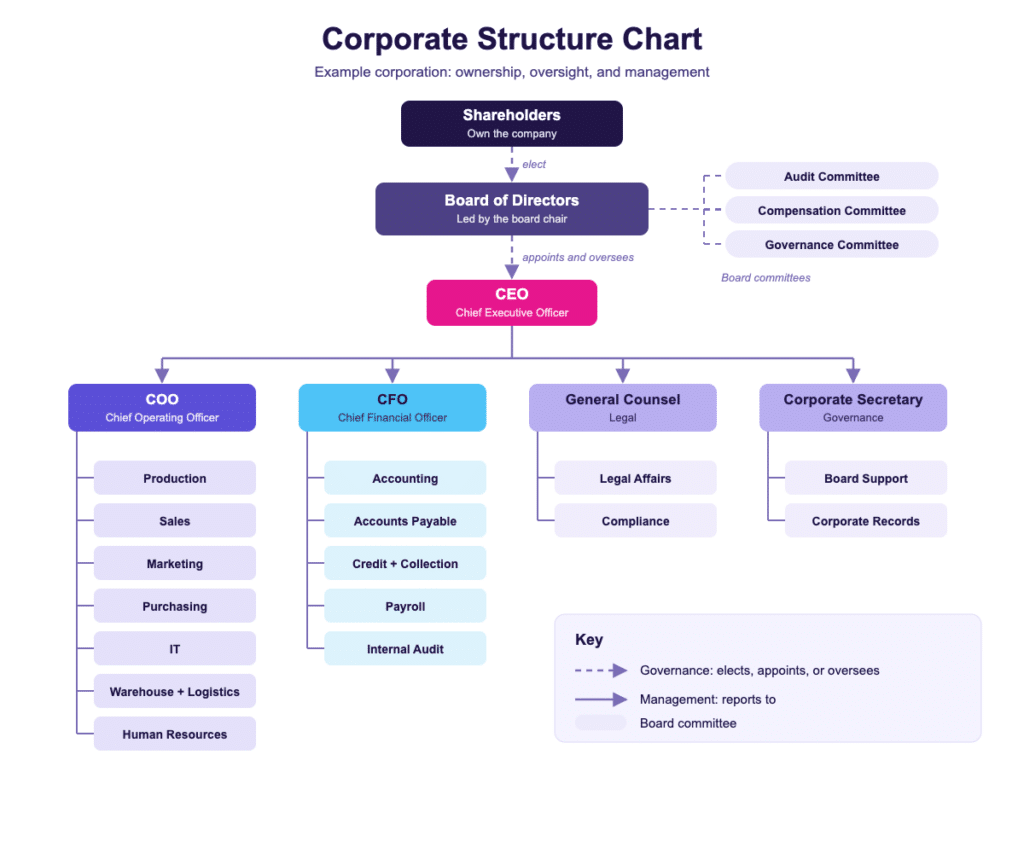
At the top, shareholders elect the board of directors. The board does much of its detailed work through audit, compensation, and governance committees, and it appoints the CEO, whom it oversees on the shareholders’ behalf. The dashed lines in the chart mark these governance relationships, where one group elects or oversees another without managing it day to day.
Below the CEO, the solid lines show who reports to whom. Four officers report directly to the CEO. The COO runs the operating departments: production, sales, marketing, purchasing, IT, warehouse and logistics, and human resources. The CFO oversees accounting, accounts payable, credit and collection, payroll, and internal audit. The general counsel handles legal affairs and compliance
Common Organizational Structures
Below the CEO, companies arrange their teams in different ways depending on size, product mix, and geography. These are the four most common models:
| Structure | How It Works | Best Fit |
|---|---|---|
| Functional | Teams are grouped by specialty (finance, marketing, operations), each led by a functional head | Companies with one main product or service |
| Divisional | Each product line, customer segment, or region runs as its own unit with its own functions | Larger companies with distinct businesses or markets |
| Matrix | Employees report to both a functional manager and a project or product manager | Organizations running many cross-functional projects |
| Flat | Few or no middle management layers; teams report close to the top | Startups and small companies that need to move quickly |
The example chart above is mostly functional: the COO and CFO each oversee departments organized by speciality. Many companies combine models as they grow, for example a divisional structure with functional teams inside each division.
Holding Company and Subsidiary Structures
In a holding company structure, a parent company owns a controlling stake in one or more separate companies, called subsidiaries. Each subsidiary is its own legal entity, often with its own board of directors and officers.
Companies use this setup to separate liability between business lines, keep acquired companies intact, or hold assets like real estate or intellectual property in a separate entity. The tradeoff is administrative. A group with ten subsidiaries may have ten boards, each with its own meetings, minutes, and filings. Our Committees and Multi-Board tool helps governance teams keep those boards organized from one place.
How Corporate Structure Changes as a Company Grows
The three levels stay the same as a company grows, but the people filing them change.
- Early-Stage Startup: The founders are often the only shareholders, directors, and officers. Because one person may hold all three roles, it matters to document which capacity they are acting in when they make a decision.
- Growing Private Company: Investors buy stock and usually negotiate board seats. The board expands to include investor directors and often an independent director, and the company adds officers such as a CFO.
- Public Company: Ownership spreads across thousands of shareholders, the board must be majority independent, and audit, compensation, and nominating committees become standard. The corporate secretary takes on SEC filings and the annual meeting.
Manage Your Board Structure With OnBoard
As a company adds committees, subsidiaries, and directors, keeping track of who sits where gets harder, especially for enterprise governance teams. OnBoard gives governance teams one place to run every board and committee, with Committees and Multi-Board support built in. Schedule a demo or start a free trial to see how it works.
Run Every Board and Committee From One PlaceA demo shows how OnBoard keeps your main board, its committees, and subsidiary boards organized under one account, so directors find the right materials and your governance team always knows who sits where.
Schedule a DemoFrequently Asked Questions
What are the three levels of corporate structure?
Shareholders, the board of directors, and corporate officers. Shareholders own the company and elect the board, the board oversees the company and appoints officers, and officers run daily operations.
What is the difference between corporate structure and organizational structure?
Corporate structure usually refers to the governance hierarchy of shareholders, board, and officers. Organizational structure describes how employees and departments are arranged below the CEO, such as functional, divisional, or matrix.
What is a corporate structure chart?
A corporate structure chart is a diagram showing reporting relationships in a company. Most show management from the CEO down; a complete chart also shows shareholders, the board, and board committees above the CEO.
About The Author

- Tyler Naples
- Tyler Naples is an SEO Strategist focused on building scalable organic growth systems for OnBoard, the leading board management software solution. He specializes in connecting high-intent traffic segments with content that ranks, resonates, and converts.
Latest entries
 USNovember 16, 2026How to Write a Board Member Welcome Letter (+ Free Template)
 AI & TechnologyNovember 13, 2026Board Management Software for Financial Services: 5 Best Vendors
 Risk & ComplianceNovember 12, 2026What is Enterprise Risk Management? (Overview, Definition, and Examples)
 AI & TechnologyNovember 4, 2026What is Board Book Software? (+ Free Vendor Evaluation Checklist)